DIY or Handyman for Door Lock and Hinge Repair?

Tightening a loose hinge screw or swapping a basic knob is a reasonable DIY job. Handyman door lock repair makes more sense when the door rubs, the latch won't line up, the frame is damaged, or a deadbolt keeps failing. If a fix takes more than one simple adjustment, the cause is usually something else, and that is where a pro saves you repeat work.
Start by figuring out what is actually wrong
Most "lock problems" are really door problems. A deadbolt that sticks in the afternoon but works in the morning is often a door that has shifted slightly in its frame. A latch that won't catch may be a hinge issue, not a lock issue.
Before you buy any parts, watch the door for a minute:
- Does it swing closed on its own, or does it drift open?
- Is the gap around the edge even, or tight in one corner?
- Does the bolt line up with the hole in the strike plate?
- Does the key turn smoothly when the door is open, but bind when it is closed?
That last one is the big clue. If the lock works fine open and fights you closed, the lock is probably fine. The alignment is off.
Common door lock and hinge problems, and who should fix them
Some jobs are simple. Others hide bigger issues. Here is a practical way to sort them.
| Problem | Likely cause | DIY-friendly? |
|---|---|---|
| Loose knob or lever | Backing screws working loose | Yes |
| Squeaky hinge | Dry pin or dirty knuckle | Yes |
| Loose hinge screws that keep spinning | Stripped screw holes in the jamb | Usually, with the right method |
| Key sticks or turns hard | Worn cylinder, debris, or misalignment | Sometimes |
| Deadbolt won't fully extend | Door sag or strike misalignment | Often a pro job |
| Door rubs the frame | Bent hinge, swollen wood, or shifted frame | Often a pro job |
| Cracked jamb near the strike | Forced entry or old split wood | Pro job |
| Replacing a lockset on a door with a new bore | Drilling and fitting | Pro job if the holes don't match |
What you can safely do yourself
A few fixes are low-risk and need only basic tools.
Tighten everything first. Use a screwdriver, not a drill, on hinge and lockset screws. Overtightening strips the wood. Check both hinge leaves, the one on the door and the one on the jamb.
Quiet a squeaky hinge. Remove the pin one hinge at a time, wipe it clean, add a light coat of lubricant made for hinges, and tap it back in. Wipe off the excess so it does not stain the paint.
Fix a stripped screw hole. Fill the hole with a few wooden toothpicks or a thin dowel and wood glue, let it set, trim flush, then drive the screw back in. For the top hinge, a longer screw that reaches the wall stud can pull a sagging door back into place.
Swap a like-for-like lockset. If the new knob or deadbolt matches the existing holes, the job is mostly unscrewing and re-screwing. Keep the old one until the new one works properly.
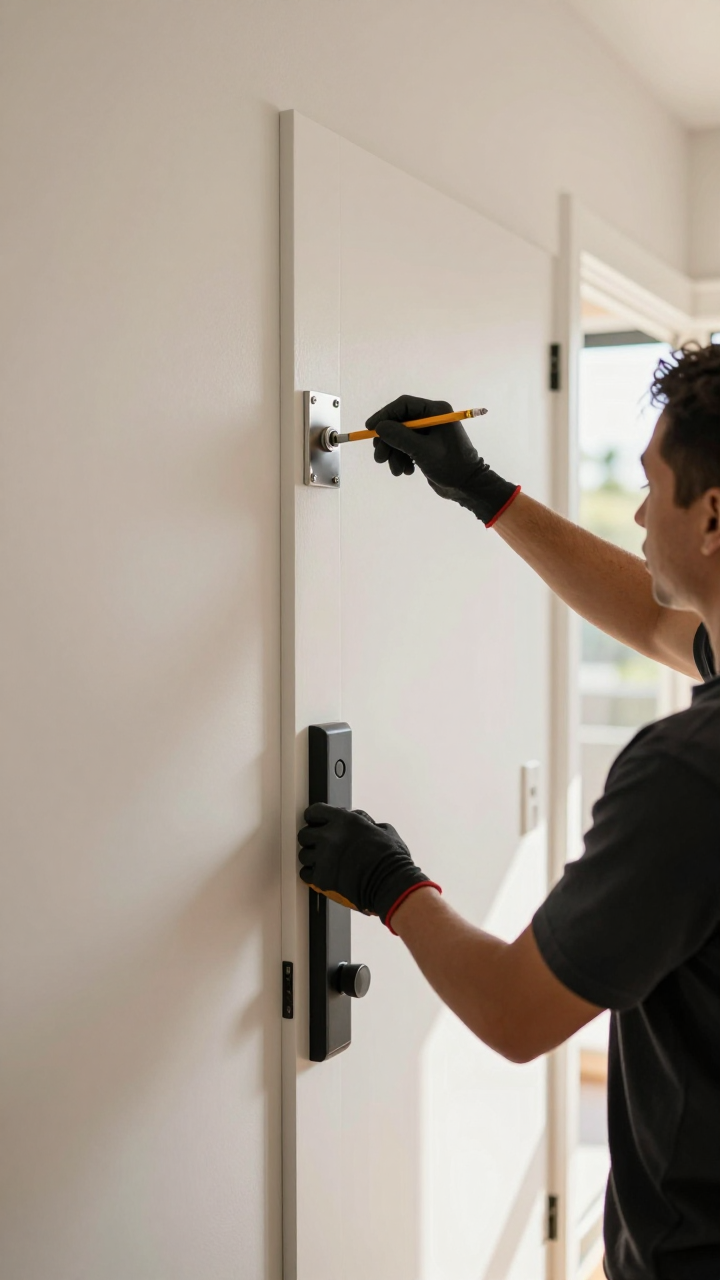
A longer screw in the top hinge can pull a slightly sagging door back into line.
Where DIY repairs go wrong
The usual trouble is treating the symptom. Someone files the strike plate hole bigger so the bolt will catch, and now the door rattles and the lock is easier to defeat. Someone planes the edge of a door that rubs, but the real cause was a loose hinge, and now there is a visible gap once the hinge is fixed.
Other common mistakes:
- Drilling a new hole in the wrong spot. Door bores have standard sizes, but a misplaced hole can't be undone without patching.
- Using short screws in a strike plate. Short screws hold the plate to the thin jamb trim only. A longer screw anchors it into the framing behind.
- Mixing up lock types. Exterior doors, interior privacy doors, and passage doors are different hardware. A bathroom knob on a front door does not protect anything.
- Forcing a stuck key. This can break the key inside the cylinder and turn a simple job into a bigger one.
In Los Angeles, homes also range from older bungalows with settled frames to newer builds with metal or fiberglass doors. Older wood doors move with the seasons and with years of settling, so a door that fit last year may rub this year. Metal and fiberglass doors can't be planed the way wood can, so adjusting the hinges and strike matters even more.

Checking where the bolt meets the strike plate shows whether the lock or the door is the real problem.
When to call a pro
Be honest with yourself about time, tools, and how much the door matters. A closet door can wait for a weekend project. A front door that will not lock cannot.
Consider a handyman for door lock repair if:
- The deadbolt does not fully extend when the door is shut.
- The door sags, sticks, or rubs even after you tighten the hinges.
- The jamb is split, soft, or cracked near the lock or hinges.
- You need to re-bore a door, or the new hardware does not match the old holes.
- The door is solid wood, metal, or a fire-rated unit in a multi-unit building, where changes can matter.
- You have already tried one fix and the problem came back.
- You are not sure whether the problem is the lock, hinge, door, or frame.
A good handyman will diagnose the cause first, rather than just replacing parts. Our locks doors service covers lock repair and replacement, hinge adjustment, strike plate fixes, and related door work.
If you are not sure what you are dealing with, you can send a photo for a written quote. Pictures of the door edge, the latch area, and the hinges help a lot.
If the job looks like it goes beyond handyman work, such as structural changes or a full door and frame replacement, ask who will handle which part. The California Contractors State License Board offers guidance on hiring for home projects, and the Los Angeles Department of Building and Safety explains when permits are involved.
A simple DIY order of operations
If you decide to try it yourself, work in this order and stop as soon as the door behaves.
- Tighten all hinge screws and lockset screws by hand.
- Check the gap around the door. Look for uneven spacing.
- Replace short screws in the top hinge with longer ones if the door sags.
- Test the latch and bolt with the door open, then closed.
- Adjust the strike plate only if the alignment is off by a small amount.
- Lubricate the hinges and the lock lightly.
- Stop and reassess if the door still binds. Further fixes may need tools or experience you don't want to learn on a front door.
FAQ
Can I fix a sagging door myself?
Often, yes. Start by tightening the hinge screws and replacing the top hinge screws with longer ones that reach the framing. If the door still drops, the hinge may be bent or the frame may have shifted, and that is worth a professional look.
Why does my deadbolt only work when the door is open?
That usually means the bolt and strike plate no longer line up. The cause may be a loose hinge, a settled door, or seasonal swelling. Fixing the alignment is better than enlarging the strike hole.
Is it okay to lubricate a lock?
A small amount of lubricant made for locks can help a sticky cylinder. Avoid heavy oils that attract dust. If the key still binds, the cylinder may be worn or the door may be misaligned.
Should I replace the lock or repair it?
If the lock is old, worn, or the key has become unreliable, replacing it is often simpler than repeated repairs. If the lock itself works fine, the problem is probably the door or the frame.
What should I have ready before a handyman visit?
Note what happens and when, such as "sticks only when closed." Take photos of the latch edge, hinges, and strike plate, and keep any spare keys or hardware you already bought.
Sources
- California Contractors State License Board: Hire a Contractor
- California Contractors State License Board: Consumers
- Los Angeles Department of Building and Safety: Permits and Inspections
Safety note: work on electrical panels, gas, structure or anything that needs a permit should be done by a licensed contractor with the required permits.
STATOX Handyman Service · Send a photo · +1 (820) 200-4919
Keep reading
 locks doorsDeadbolt vs Smart Lock: Which Fits Your Home Better?Deadbolt vs smart lock: compare security, convenience, batteries, and fit for Los Angeles homes so you can pick the right lock for your front door.
 locks doorsDoor Sticking or Not Latching? Common Causes and FixesDoor not latching or sticking in your LA home? Learn the common causes, simple fixes, and when to stop DIY, so you can sort it out with real confidence.
 locks doorsFront Door Lock Replacement: What to Expect on Visit DayPlanning a front door lock replacement in Los Angeles? Walk through visit day step by step, from prep to testing, so nothing catches you off guard.